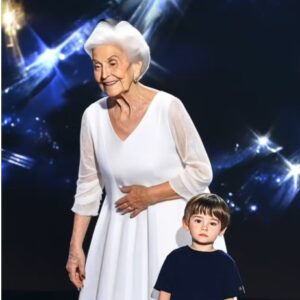
I hadn’t planned on staying that long. I’d just brought my grandma in for some tests, and we were supposed to be out by noon. But then the lab was backed up, her pressure dipped a little, and before I knew it, we were on hour five in the waiting room.
She got cold, even though it wasn’t cold in there. I wrapped my jacket around her legs and offered to get her water. She didn’t answer—just leaned over and curled herself against me like she used to when I was a kid afraid of thunderstorms.
“She’s lucky to have you,” one of the nurses said in passing.
I nodded, but I didn’t say anything. Because what I hadn’t told anyone yet—not even my sister—was that lately, she didn’t always remember who I was.
Earlier that morning, she called me “Teddy.” That was my grandfather, who’d passed away almost 15 years ago. Then, when we pulled up to the clinic, she called me “Coach.” I never played sports a day in my life.
But right there in that chair, with the cheap overhead lights and the Christmas tree blinking in the corner, she wrapped both arms around my chest and whispered, “Don’t leave me again.”
I just held her tighter. I didn’t correct her.
The thing is, she looked calm for the first time in days. Like she finally felt safe.
I didn’t have the heart to ask what she meant by “again.”
The tests came back inconclusive that day. They wanted to keep her overnight for observation. Grandma got agitated when they said that, pulling at the sheets and muttering about needing to get home to water her plants. I stayed with her, of course. Slept in the uncomfortable chair next to her bed, waking up every few hours to make sure she hadn’t tried to get up on her own.
The next morning, she was a little more lucid. She looked at me, her eyes clear for a moment, and said, “Thank you, Liam. You’re a good grandson.”

Relief washed over me. “You remember me, Grandma?”
She smiled, a faint, familiar smile. “Of course, I remember you. You’re my Liam.” But then the clarity faded, and she was looking past me, a faraway look in her eyes. “Teddy, did you remember to bring the newspaper?”
It was like riding a rollercoaster, these moments of recognition followed by confusion. My sister, Sarah, arrived later that day. I told her about Grandma calling me Teddy and Coach, about the whispered plea not to leave her again.
Sarah squeezed my hand. “It’s the dementia, Liam. The doctor warned us this might happen.”
I knew, logically, that she was right. But it still felt like a punch to the gut. This woman, who had taught me how to bake cookies, who had read me stories until I fell asleep, who had always been my rock, was slipping away. Piece by piece.
Over the next few weeks, the episodes became more frequent. Sometimes she thought I was her brother, Thomas. Other times, she looked right through me like I wasn’t even there. But through it all, there were these moments, these flashes of recognition, that kept me going. A squeeze of my hand, a whispered “Liam,” a brief spark of the old Grandma shining through.
One afternoon, I was sitting with her, reading aloud from her favorite book, “Little Women.” She was usually restless, fidgeting and trying to get up, but that day, she was surprisingly calm. As I read the part where Jo March says goodbye to her family to go to New York, Grandma reached out and took my hand.
“Don’t go, Teddy,” she said, her voice small and frail.
I stopped reading, my throat tight. “I’m not going anywhere, Grandma. I’m right here.”
She looked at me, her eyes filled with a sadness that cut me to the core. “You always leave. You left me all alone.”
I didn’t know what she was talking about. Grandpa had been gone for years. I had never left her. But in that moment, it didn’t matter what was real and what wasn’t. All that mattered was the fear in her eyes, the pain in her voice.
“I’m not going anywhere,” I repeated, squeezing her hand. “I promise. I’ll always be here.”
She clung to my hand, her grip surprisingly strong. “Promise?”
“I promise,” I said, and as I looked into her confused, tear-filled eyes, I knew I would keep that promise, no matter what.
The twist came a few days later, during one of her more lucid moments. She was sitting up in bed, looking out the window at the autumn leaves falling outside.
“Liam,” she said, her voice clear and strong. “Do you remember Danny?”
Danny. My uncle. Her son. He had died in a car accident when I was a baby. I barely remembered him.
“Yes, Grandma,” I said softly. “I remember hearing stories about him.”
A tear rolled down her cheek. “He left me too soon. Just like your grandfather.”
And then it clicked. Teddy. Coach. The plea not to leave her again. She wasn’t just confusing me with Grandpa. She was confusing me with her son, Danny. The “again” wasn’t about Grandpa. It was about Danny. About the unbearable pain of losing a child.
It was a revelation that shattered my heart and put everything into perspective. Her confusion wasn’t just random. It was rooted in deep, unresolved grief. In her mind, I had become a stand-in for the son she had lost too soon.
From that day on, I didn’t correct her anymore. When she called me Teddy or Coach, I answered. When she talked about Danny, I listened. I became whoever she needed me to be in that moment, a grandson, a husband, a son. It didn’t matter who she thought I was, as long as I could bring her some comfort, some peace.
The rewarding conclusion wasn’t a miraculous recovery or a sudden return of her memory. It was something quieter, something more profound. It was the day she looked at me, called me Liam, and then said, “You remind me so much of Danny. He had your kind eyes.”
It wasn’t a perfect moment of clarity, but it was a bridge. A connection between the past and the present, between her son and her grandson. It was a moment of understanding, not just for her, but for me too. I realized that even in the fog of dementia, love endures. Memories may fade, faces may blur, but the heart remembers.
My grandma eventually passed away peacefully in her sleep, surrounded by family. In the days and weeks that followed, I found comfort in the memories we had shared, in the moments of connection we had found even in the midst of her illness. And I carried with me the lesson she had taught me: that love is more powerful than memory, that even when the mind forgets, the heart remembers.
The life lesson here is to be present, to be patient, and to love fiercely, even when it’s hard. Sometimes, the greatest gift we can give someone is simply to be there, to listen, and to accept them for who they are in that moment. And sometimes, in the midst of loss and confusion, we can find unexpected connections and a deeper understanding of the enduring power of love.
If this story touched your heart, please share it with someone who needs to hear it. And if you enjoyed it, give it a like. Your support means the world.